




Get FP&A best practices, research reports, and more delivered to your inbox.
Becoming a Chief Financial Officer (CFO) is one of the most respected milestones in finance. It’s also one of the hardest titles to reach.
Today, the role demands much more than just financial expertise. It involves raising capital, managing cash, keeping the business financially disciplined, partnering with the CEO on strategy, and even staying abreast of tech trends like AI.
So, what does it take to reach this coveted seat?
We used the 2025 Forbes Cloud 100 list for our benchmarks. The Cloud 100 is a prestigious list that reflects the who's who of high-growth software companies and finance leadership.
There's no single perfect background, but the patterns are clearer than ever: analytical training, early exposure to core finance work, and several years of experience in other senior finance roles are the ingredients required to reach the top job.
Keep reading to see what we found. 👇

Key takeaways
{callout}
Methodology note: Our analysis is solely based on publicly available data. 82 of the Forbes Cloud 100 companies had a named CFO, another 4 had a senior finance leader without CFO in the title, and 14 had no current finance leader publicly identifiable.
{/callout}
- 61% of leaders studied a finance-adjacent field such as finance, accounting, economics, business, commerce, or management
- 64% have a postgraduate degree, and 73% of those advanced degrees are MBAs
- Among leaders with a non-finance-adjacent undergraduate major, 81% later earned a postgraduate degree, and 88% of those advanced degrees were MBAs
- The most common starting points were:
- Accounting (31%)
- Corporate finance (26%)
- Investment banking (23%)
- Consulting (7%)
- Engineering (7%)
- 85% of CFOs were hired externally, 13% were promoted internally, and 3% followed founder or board-to-CFO paths
- The average time from graduation to CFO was 19 years, and the median was 20 years
Education
Where you studied and what you studied still don’t make or break a finance career on their own. But the data does show a strong correlation between analytical training, business fluency, and reaching the top finance seat.
Here are the patterns on school choice, field of study, and advanced education.
Where they studied
Most assume that CFOs are primarily sourced from the Ivy League. While these elite schools do produce more than their fair share of finance chiefs, most graduated elsewhere—although few came from outside the top 100.
Among the 76 finance leaders whose undergraduate school was publicly identifiable, no single university dominated the sample. Harvard appeared four times. Santa Clara University, UC Berkeley, and Stanford each appeared three times. Yale, Williams, Cornell, and Bar-Ilan each appeared twice. After that, the list spread out quickly.
That breadth matters. Of the roughly 68 unique undergraduate schools represented in the data, around 60 appeared only once. In other words, there is no single “CFO school.” The real pattern is that leaders come from a wide range of institutions, especially those with strong analytical programs and proximity to technology or finance ecosystems.
So yes, pedigree can help. But the updated data suggests the stronger signal is less about one elite institution and more about building a career on a rigorous educational foundation, then compounding it with execution over time.
What they studied
Undergraduate major matters more than brand-name school prestige. Among the 70 leaders whose undergraduate major was publicly identifiable, 61% studied finance-adjacent subjects such as finance, accounting, economics, business, commerce, or management. That is still the clearest educational throughline in the updated dataset.
But the more interesting signal shows up outside that bucket.
For leaders whose undergraduate background was not finance-adjacent, 81% later earned a postgraduate degree. And among those advanced degrees, 88% were MBAs. That is a strong indicator that professionals from nontraditional backgrounds often use graduate education to build the finance and operating toolkit expected of top finance executives.

Across the full identified sample, 64% of current finance leaders have a publicly traceable postgraduate degree, and 73% of those advanced degrees are MBAs.
The implication is straightforward: you don’t need a perfectly linear educational path to become CFO. But if your undergraduate background is outside the traditional finance lane, advanced education—especially an MBA—still appears to be a common accelerator.
Career choices
Education matters, but it is only part of the equation. Career choices—especially the first lane you enter and the roles you stack along the way—still shape the road to the CFO seat in a meaningful way.
First finance roles
The first role data still shows a remarkably familiar pattern.
Among the 88 leaders whose starting lane was publicly identifiable, 31% began in accounting, 26% in corporate finance, and 23% in investment banking. Consulting and engineering each accounted for 7%, with the rest spread across smaller buckets such as law, operations, entrepreneurship, and private equity.
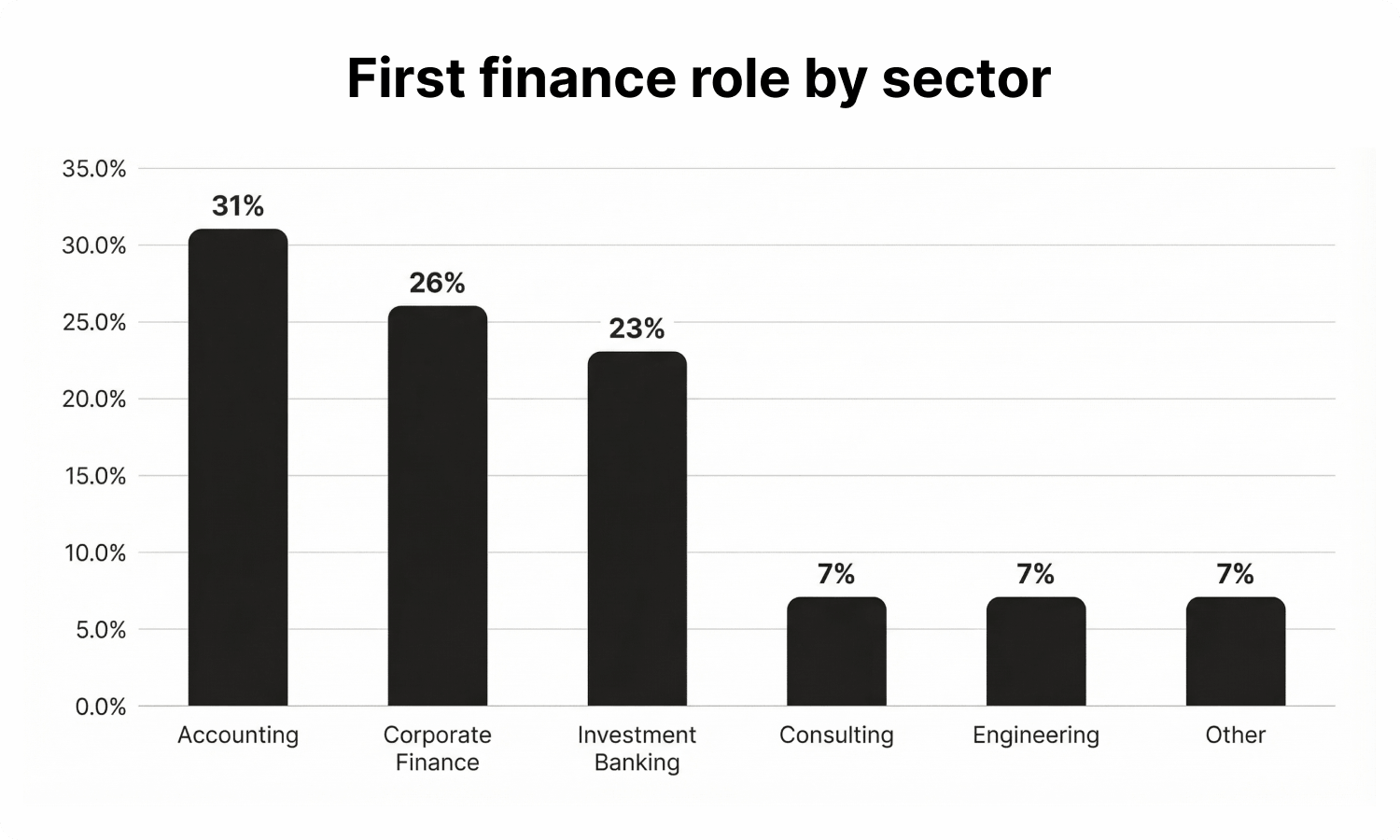
The message is not that there is one mandatory route. It is that future CFOs still tend to start in roles that build financial rigor early: closing books, understanding operating cadence, modeling performance, evaluating deals, or supporting strategic decisions.
One small but notable finding in the dataset is the visibility of engineering backgrounds. In an AI-heavy Cloud 100 cohort, that is a reminder that modern finance leadership increasingly values technical fluency alongside traditional finance training.
Longest finance roles
Public executive bios rarely disclose exact tenure for every stop along the journey, so this is the most directional section in the data.
What the updated data does show clearly is that the most common launch pads into today’s Cloud 100 finance seats are prior CFO roles and senior finance leadership positions such as VP of Finance, SVP of Finance, Head of Finance, or strategic finance leadership roles.

That makes sense. The modern CFO seat increasingly goes to operators who have already owned a real finance function somewhere else—planning, fundraising, M&A, public-company readiness, or cross-functional decision support—not just people with impressive credentials on paper.
Number of roles
Most finance leaders had 6-10 roles before reaching the CFO seat.

That should be treated as directional rather than definitive. But it still reinforces the broader point: most CFOs do not make one giant leap. They build a sequence of increasingly strategic roles over time.
Getting promoted vs. hired
The data makes it clear: future CFOs should not count on one internal promotion to get to the top.
Among the 80 leaders whose transition path was publicly traceable, 85% were external hires, 13% were internal promotions, and 3% came through founder or board-to-CFO paths.
The external market still dominates the CFO seat.
That does not mean internal promotion never happens. It does. But the updated data suggests that the highest-probability path is still to build a resume that travels well—one that signals you can step into a bigger company, a more complex operating model, or a more strategic finance mandate.
One more directional note: in the subset where both timing data and transition path were available, internal promotions reached the CFO seat faster than external hires. The internal sample is small, so that should not be overinterpreted, but it does suggest that strong succession planning can accelerate the final step when it exists.
Time to ascend to CFO
No matter what path you take, one thing in the data is unmistakable: becoming a CFO is still a long game.
Using midpoint estimates for ranges and conservative floor estimates for "+" values, the average time to CFO in the cleaned dataset was 19 years, with a median of 20 years.

That means even in one of the fastest-moving corners of software, the route to the CFO seat usually takes about two decades.
For early- and mid-career finance professionals, that is both humbling and clarifying. The job usually goes to leaders who have built judgment over a long period of time—not just people with a sharp spreadsheet or a prestigious logo on their resume.
Final thoughts
While the finance leaders in this dataset took different routes to the top, the data points to a fairly consistent playbook:
- Build a strong analytical foundation early, ideally in accounting, corporate finance, or investment banking
- Do not assume your undergraduate major locks in your ceiling; nontraditional majors still show up, especially when paired with graduate education
- Treat an MBA as a common accelerator rather than a hard requirement
- Expect the path to take roughly 20 years, not five
- Seek roles that increase real ownership over planning, capital, operations, and strategic decision-making
- Do not rely exclusively on an internal promotion; external moves remain a major part of how finance leaders reach the CFO seat
The bigger lesson is that the CFO role has continued to evolve from steward to strategic operator. The leaders who reach it are not just technically strong. They are translators between data and decisions.

Get FP&A best practices, research reports, and more delivered to your inbox.